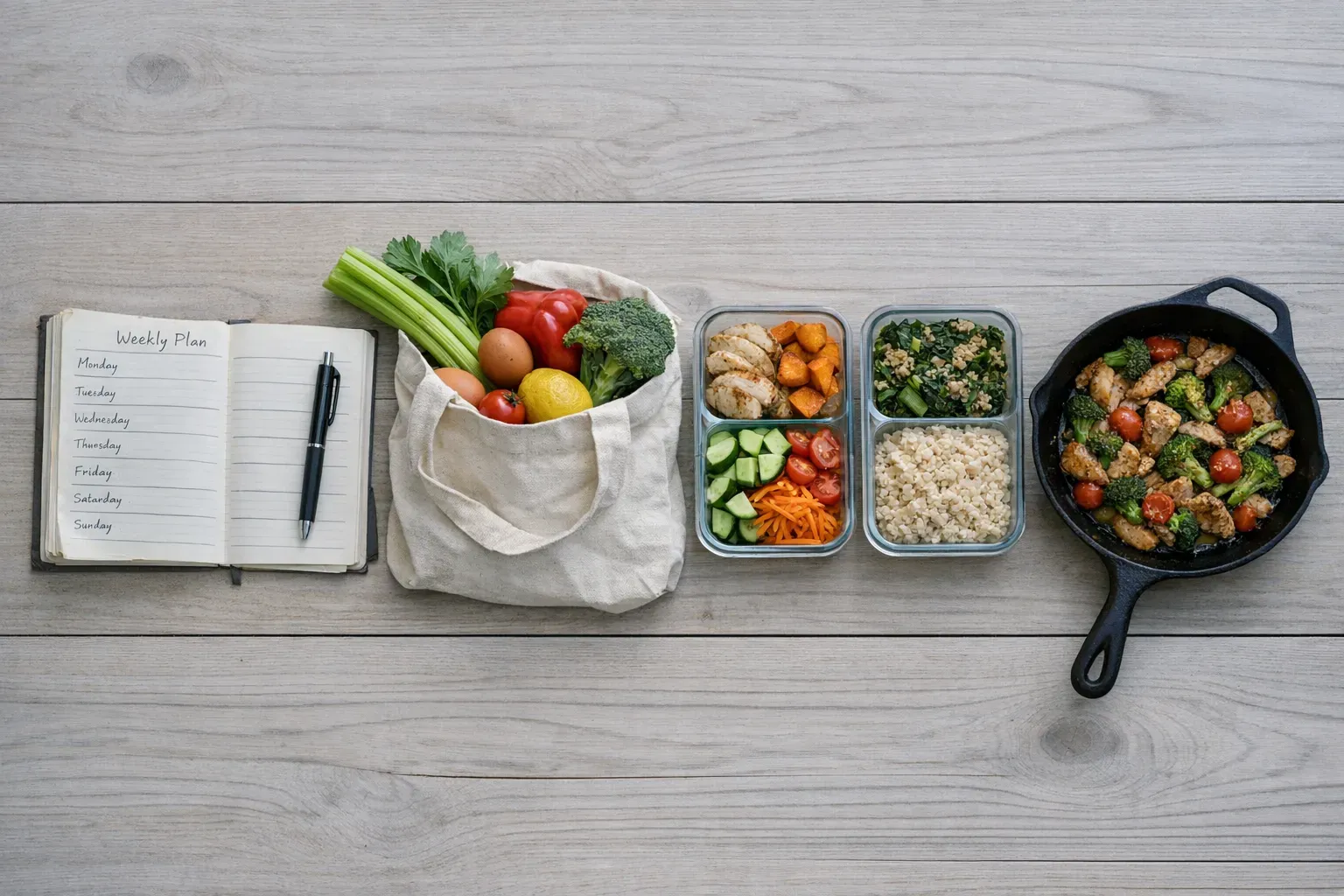
The Complete Weekly System is an integrated approach to feeding your family that connects four essential activities — planning what to cook, shopping for ingredients, prepping components, and executing weeknight dinners — into one smooth, sustainable cycle. Instead of treating each meal as a separate crisis to solve when hunger strikes, you establish a predictable rhythm that handles food decisions once per week, freeing up mental energy and time for everything else that matters.
This guide shows you exactly how the system works, provides a day-by-day framework, and explains how each piece reinforces the others. By the end, you’ll understand not just what to do, but when to do it and why it creates such dramatic improvements in stress, time, and food quality.
Key Takeaways
- Connect planning, shopping, prepping, and cooking into one weekly cycle — spending 4-6 hours on Sunday saves 8-12 hours during the week
- Plan 4-5 dinners per week (not 7), match meal complexity to each night’s available time and energy, and build in leftover and takeout nights
- Prep components on Sunday (chopped vegetables, cooked grains, marinated proteins) so weeknight dinners become 15-20 minute assembly
- Each pillar reinforces the others: planning makes shopping efficient, shopping makes prep purposeful, and prep makes cooking fast
- Start small — just plan meals week one, add shopping week two, add prep week three — and the system becomes automatic by week four
In This Article
- Why You Need a System (Not Just Strategies)
- The Four Pillars of the Weekly System
- The Complete Weekly Timeline
- How the Pillars Reinforce Each Other
- Customizing the System for Your Life
- Troubleshooting Common System Failures
- What Makes This a System (Not Just Tasks)
- Beyond Efficiency: The Deeper Value
- Frequently Asked Questions
- Starting This Week
- Bringing It All Together
Why You Need a System (Not Just Strategies)
Most people approach weeknight cooking with a collection of disconnected tactics. They try meal planning one week, then forget about it. They batch cook on random Sundays. They make grocery lists sometimes. Each strategy helps momentarily, but nothing sticks because the pieces don’t connect into a repeatable routine.
A system is different. A system is a set of connected habits that reinforce each other and become automatic through repetition.
When you plan meals on Sunday, shopping becomes straightforward — you buy exactly what the plan requires. When you shop with a plan, meal prep becomes obvious — you prep the ingredients you bought for the meals you planned. When you prep on Sunday, weeknight cooking becomes quick assembly rather than starting from scratch.
Each component makes the others easier. The system creates momentum.
You eliminate decision fatigue. Food decisions happen once per week during planning, not seven times when you’re tired at 6pm. You stop spending mental energy on “what should we eat?” and redirect that energy toward your actual priorities.
You save real money. Planned shopping prevents impulse purchases. Prepped ingredients prevent waste. Easier weeknight cooking prevents expensive last-minute takeout. Most families save $150-250 per month just by following a consistent system.
You eat better without trying harder. When healthy ingredients are prepped and ready, healthy meals become the path of least resistance. When you plan a weekly balance of vegetables, proteins, and meaningful family recipes, good nutrition happens automatically.
You reclaim time. The system requires 4-6 hours on Sunday (planning, shopping, prepping), but saves 8-12 hours during the week by eliminating multiple store runs, nightly decision-making, and time-consuming prep work when you’re already tired.
Most importantly, a system preserves what makes food meaningful. When cooking isn’t a nightly crisis, you have space to make Grandma’s Sunday gravy, teach your kids how to roll meatballs, and gather everyone around the table for meals that build connection and tradition.
That’s what a system enables that scattered tactics never can.
The Four Pillars of the Weekly System
The system has four core components. Each one matters, and they work best when connected in a specific order.
Pillar 1: Weekly Meal Planning
Every week, you choose what meals you’ll cook. Not vague ideas like “something with chicken,” but specific recipes or familiar meals.
Meal planning is the foundation because everything else builds on it. You can’t build an efficient grocery list without knowing what you’re cooking. You can’t prep strategically without a plan for how ingredients will be used.
Planning happens once per week, takes 20-45 minutes, and drives all subsequent decisions. For complete details on how to meal plan effectively, see our beginner’s guide to meal planning.
What planning includes:
- Reviewing your calendar to match meals to available time
- Choosing 4-6 dinner recipes for the week
- Balancing quick meals, moderate effort meals, and intentional leftovers
- Building in flexibility (takeout nights, eating out, leftover nights)
- Writing down the plan where everyone can see it
Pillar 2: Strategic Grocery Shopping
With your meal plan complete, you create an organized grocery list that includes every ingredient for planned meals plus weekly staples for breakfast, lunch, and snacks.
Strategic shopping means one focused trip per week with a clear list, organized by store layout, that ensures you buy what you need and avoid what you don’t.
Our grocery list template for healthy eating provides a comprehensive framework organized by category. Use it to build your weekly shopping list based on the meals you planned.
What strategic shopping includes:
- Checking pantry, fridge, and freezer before shopping to avoid duplicates
- Building a categorized list based on your meal plan
- Shopping the perimeter first (produce, proteins, dairy)
- Sticking to your list to avoid impulse purchases
- Doing one major shop per week instead of multiple reactive trips
Pillar 3: Sunday Meal Prep
After shopping, you invest 2-4 hours prepping the components and ingredients that make weeknight cooking faster. This isn’t about making complete meals to reheat — it’s about handling the time-consuming prep work while you have energy and time.
Meal prep transforms weeknight cooking from a 60-minute ordeal into 15-20 minutes of simple assembly.
The Meal Prep Sunday guide walks through exactly what to prep, what to cook fresh, proper storage techniques, and a detailed timeline from start to finish.
What meal prep includes:
- Washing and chopping vegetables for the week
- Cooking grains, pasta, or other starches in batch
- Marinating or portioning proteins
- Roasting proteins or vegetables that reheat well
- Making sauces, dressings, or other flavor components
- Prepping breakfast and snack components
Pillar 4: Weeknight Execution
With planning, shopping, and prep complete, weeknight cooking becomes fast and low-stress. You’re not figuring out what to make or starting from scratch — you’re assembling pre-prepped components into the meals you already planned.
Tuesday night, you pull out Sunday’s marinated chicken, Sunday’s chopped vegetables, and Sunday’s cooked rice. Stir-fry takes 12 minutes. Wednesday, you reheat Monday’s roasted chicken, steam fresh broccoli, and make a quick salad with washed greens. Dinner in 15 minutes.
What weeknight execution includes:
- Following the meal plan (with flexibility to swap days if needed)
- Using prepped components to minimize active cooking time
- Cooking the fresh elements that weren’t prepped
- Involving family members in simple tasks (setting the table, making salad, etc.)
- Enjoying dinner without the stress of figuring it out on the fly
The Complete Weekly Timeline
Here’s how the system flows across a typical week. Adjust days and times to fit your schedule — the pattern matters more than the specific timing.
Sunday Morning: Plan (20-45 minutes)
9:00am - 9:45am: Create your weekly meal plan
Sit down with coffee and your recipe collection. This is your focused planning time.
-
Check your calendar. What nights are you home? What nights are busy with activities? When do you have more time to cook?
-
Decide how many meals to plan. Most families plan 4-5 new dinners plus 1-2 leftover nights and 1 takeout/eating out night.
-
Choose specific meals. Balance quick meals (20 minutes), moderate meals (30-45 minutes), and slow cooker meals. Match complexity to your schedule — quick meals on busy nights, more involved recipes when you have time.
-
Write down the plan. Create a simple chart showing which meal happens which night. Post it on the fridge or keep it in a shared note.
-
Build your grocery list based on the meals you chose and weekly staples you need. Use the template from our grocery list guide to organize by category.
-
Check what you have. Cross off items already in your pantry, fridge, or freezer. Only buy what you actually need.
Sunday Afternoon: Shop (45-90 minutes)
11:00am - 12:30pm: One focused grocery trip
With your organized list in hand, do your weekly shopping. The goal is to get everything you need in one efficient trip.
-
Shop the perimeter first: produce, proteins, dairy. These fresh items form the foundation of healthy meals.
-
Work through center aisles systematically: pantry staples, canned goods, grains, frozen items.
-
Stick to your list. Impulse purchases are how budgets balloon and pantries get cluttered with ingredients you don’t use.
-
Buy ingredients you’ll actually use. Aspirational healthy ingredients that sit unused don’t help anyone.
-
Get home and put groceries away immediately. The faster you put away perishables, the fresher they stay.
For tips on avoiding common shopping pitfalls, read about grocery shopping mistakes to watch out for.
Sunday Afternoon/Evening: Prep (2-4 hours)
1:00pm - 5:00pm: Meal prep session
This is your focused prep time. Put on music or a podcast, clear your workspace, and work through the components systematically.
1:00pm - 1:30pm: Start long-cooking items
- Preheat oven for roasting proteins or vegetables
- Start slow cooker if making pulled pork, shredded chicken, or chili
- Begin cooking large batches of rice, quinoa, or other grains
- Set eggs to boil if you want hard-boiled eggs for the week
1:30pm - 2:30pm: Vegetable prep
- Wash all produce for the week
- Chop vegetables for multiple meals (onions, peppers, broccoli, carrots, etc.)
- Wash and dry salad greens, store with paper towels
- Store vegetables in airtight containers, organized by when you’ll use them
2:30pm - 3:30pm: Protein prep
- Portion and marinate raw proteins for later in the week
- Shred or slice cooked proteins from the oven or slow cooker
- Brown ground meat for tacos or pasta sauce
- Portion proteins into meal-sized containers
3:30pm - 4:15pm: Sauces, dressings, and extras
- Make sauces (marinara, pesto, stir-fry sauce, etc.)
- Mix salad dressings
- Prep breakfast components (overnight oats, egg muffins, cut fruit)
- Portion snacks (nuts, cut vegetables with hummus, etc.)
4:15pm - 5:00pm: Final assembly and organization
- Assemble any complete meals you’re prepping
- Portion cooked grains into containers
- Label everything with contents and date
- Organize fridge strategically — Monday’s items front, later-week items back
- Clean kitchen and put away equipment
Monday - Friday: Weeknight Cooking (15-45 minutes per night)
6:00pm - 6:30pm: Quick weeknight dinners
Each evening, you’re executing the meal you planned and prepped. Cooking time varies based on the meal’s complexity, but prep work is already done.
Monday: Slowest night of the week, so maybe this is your quick meal. Use Sunday’s prepped components for a fast stir-fry or one-pot pasta dish. 15-20 minutes.
Tuesday: Mid-week, still busy. Perhaps this is leftover night — Monday’s recipe made in a larger batch, or Sunday’s roasted chicken transformed into tacos or salad. 10 minutes.
Wednesday: Hump day. Maybe this is when you cook the marinated chicken that’s been flavoring since Sunday. Pair with Sunday’s prepped vegetables and cooked rice. 25 minutes.
Thursday: Energy might be low, so this could be slow cooker meal day — the meal that cooked while you were at work, now ready to serve. Or use a freezer meal prepped weeks ago. 15 minutes.
Friday: Perhaps this is takeout night or eating out — a break from cooking to end the week.
Saturday: More time available, so this might be when you make a more involved family recipe — Grandma’s meatballs, homemade pizza night with the kids helping, or a special weekend breakfast.
Sunday: Lighter meal or leftovers, because you’re about to start the cycle again.
The exact schedule varies by family, but the pattern is consistent: planned meals matched to available time and energy, with prepped components making execution quick.
For quick dinner ideas that work perfectly within this system, check out our guide to 20-minute dinners for busy weeknights.
Sunday (Next Week): Repeat
9:00am: Start the cycle again
Review how last week went. What meals worked well? What took longer than expected? What got skipped?
Adjust this week’s plan based on what you learned. Meal planning is a skill that improves with practice.
Then repeat the cycle: plan, shop, prep, cook.
How the Pillars Reinforce Each Other
The power of the system is in how the pieces connect.
Planning enables efficient shopping. When you know exactly what meals you’re making, you know exactly what to buy. No wandering the aisles wondering what you might need. No forgotten ingredients that require a second trip Tuesday night.
Shopping enables strategic prep. When you bought specific ingredients for specific meals, Sunday prep has clear purpose. You chop the peppers you bought for Wednesday’s fajitas and Friday’s stir-fry. You cook the rice that pairs with Monday’s curry and Thursday’s burrito bowls.
Prep enables quick weeknight cooking. When vegetables are washed and chopped, proteins are marinated or cooked, and grains are ready to reheat, Tuesday’s dinner comes together in 15 minutes instead of 60. The time investment on Sunday creates time savings every single evening.
Weeknight cooking validates the plan. When Wednesday’s meal tastes good, comes together quickly, and your family enjoys it, you remember which recipes belong in regular rotation. The following Sunday, planning becomes easier because you know what works.
Successful weeks build confidence and habit. After 3-4 weeks of following the system, it stops feeling like a project and becomes automatic routine. You don’t think about whether to meal plan — it’s just what you do Sunday morning.
This is why scattered tactics fail while systems succeed. Each component supports and strengthens the others, creating momentum that carries you forward.
Customizing the System for Your Life
The framework is universal, but the details must fit your specific situation.
If You Work Full-Time
- Keep weeknight meals to 30 minutes or less. Use the full 4 hours of Sunday prep to handle the time-consuming work.
- Rely heavily on slow cooker meals (set up in the morning, ready when you get home) and one-pot dishes.
- Prep breakfast and lunch components on Sunday so mornings and midday are low-stress.
- Batch cook proteins on Sunday and use them three different ways during the week to maximize efficiency.
If You Have Young Kids
- Accept that plans will change. Build extra flexibility — leftovers, easy backup meals, flexibility to swap days.
- Involve kids in age-appropriate tasks. Toddlers can wash vegetables. Elementary kids can mix dressings or set the table. Teenagers can chop or cook simple components.
- Keep meals simple and kid-friendly most nights, with one or two more adventurous meals.
- Prep grab-and-go snacks so after-school hunger doesn’t derail dinner plans.
If You’re Cooking for One or Two
- Plan 3-4 meals, not seven. Cook Sunday and Wednesday, eat leftovers the other nights.
- Embrace the freezer. Batch cook and freeze individual portions. Your “meal prep” becomes pulling pre-made meals from the freezer.
- Buy smaller quantities or freeze half immediately after shopping.
- Use the system to avoid food waste — single portions often mean fresh ingredients spoil before being used. Planning and prep prevent this.
If You’re on a Tight Budget
- Plan meals around what’s on sale. Check grocery store flyers before planning, build meals around discounted proteins and produce.
- Build ingredient overlap into your meal plan. If you buy a bunch of cilantro, use it in three different meals that week.
- Rely on affordable staples: beans, lentils, eggs, rice, pasta, seasonal vegetables.
- Batch cook and freeze proteins when they’re on sale. Use throughout the month.
For detailed strategies on eating well within budget constraints, see our guide on meal planning for a family of four on a budget.
If You Have Dietary Restrictions
- Build your meal plan around compliant recipes first. Don’t try to adapt regular recipes every week — curate a collection of recipes that already fit your needs.
- Prep ingredients separately when cooking for mixed needs (gluten-free family members, vegetarians, etc.). Everyone can build their own bowls or tacos from shared components.
- Use the grocery template to find appropriate alternatives. Our grocery list template includes customization tips for gluten-free, dairy-free, vegetarian, vegan, keto, and paleo approaches.
Troubleshooting Common System Failures
Even with a solid framework, challenges arise. Here’s how to handle them.
Problem: Sunday Gets Too Busy to Plan/Prep
Solution: Shift the system to different days. Plan Thursday evening, shop Friday, prep Saturday. Or split it — plan Sunday, shop Monday, prep Wednesday. The day matters less than consistency.
Problem: You Planned Meals But They Don’t Get Cooked
Solution: Your plan doesn’t match reality. Either the meals are too complex for weeknight energy levels, or you’re planning too many meals. Scale back to 3-4 dinners instead of 6-7. Focus on simpler recipes. Build in more leftover nights.
Problem: Prepped Food Spoils Before You Use It
Solution: You’re prepping too far ahead or storing incorrectly. Only prep vegetables you’ll use within 4 days. Freeze proteins for later in the week. Use airtight containers and paper towels to extend freshness. See storage tips in the Meal Prep Sunday guide.
Problem: Family Complains About the Planned Meals
Solution: Involve them in planning. Ask for input Sunday morning — “What sounds good this week?” Let kids choose one meal. Build in favorites alongside new recipes. The system works better when it includes meals people actually want to eat.
Problem: The System Feels Overwhelming
Solution: Start smaller. Week one, just do the planning step. Week two, add strategic shopping. Week three, add 1 hour of light prep. Gradually build the full system over a month. Partial implementation still provides benefits.
Problem: You Forget What You Planned
Solution: Make the plan visible. Write it on a whiteboard on the fridge. Keep it in a shared phone note. Send a family group text with the week’s meals. The plan only helps if you remember to follow it.
What Makes This a System (Not Just Tasks)
Understanding why this is a system and not just a to-do list matters.
Systems run on habits, not motivation. After 4-6 weeks of repeating the Sunday planning-shopping-prep cycle, you don’t think about whether to do it. It’s just what Sunday is. Habit carries you forward even on weeks when motivation is low.
Systems have feedback loops. When Monday’s dinner comes together easily because you prepped Sunday, you experience the direct benefit. That reinforces the behavior, making you more likely to prep next Sunday. Positive feedback strengthens the system.
Systems create compounding returns. Week one, meal planning feels slow and awkward. Week four, you plan in 20 minutes because you know your favorite recipes and patterns. Week eight, you’ve refined your grocery template so shopping is fast. Week twelve, you’ve built a repertoire of 15 reliable meals that rotate seamlessly. The system gets easier and more effective with repetition.
Systems fail gracefully. Miss a week of meal planning? You still have the habit structure to return to next week. Have a chaotic Sunday and can’t prep? You still have the meal plan to guide weeknight shopping and cooking. Systems are resilient in ways that motivation-dependent tactics are not.
This is why establishing the full weekly system transforms food management in ways that occasional meal planning never can. You’re building infrastructure, not just executing tasks.
Beyond Efficiency: The Deeper Value
Yes, this system saves time. Yes, it saves money. Yes, it makes healthy eating easier.
But the real value is what it protects.
When food decisions are handled systematically on Sunday, you’re not spending Tuesday evening stressed and exhausted, staring into the fridge while hungry kids complain. You’re calmly pulling out the marinated chicken you prepped, heating the rice you cooked, and tossing the salad greens you washed.
That mental calm creates space for presence. Space to actually talk with your kids during dinner instead of frantically multitasking. Space to teach them how to make the family recipes you want to pass down. Space to choose Grandma’s Sunday sauce not because you’re a superhero with infinite time, but because the tedious prep work is already handled and now you can focus on the parts that matter — showing your daughter how much basil to add, telling the story of how your grandmother made this sauce every Sunday, creating the kind of food memory that lasts a lifetime.
The system isn’t about optimization. It’s about preservation.
When you remove the chaos and crisis from weeknight cooking, you create room for the rituals and recipes that build family identity. That’s what this system really provides.
Frequently Asked Questions
How long does it take to establish this as a true habit?
Most people need 4-6 weeks of consistent repetition before the system feels automatic rather than effortful. The first two weeks feel awkward and slow. Weeks 3-4, you start finding your rhythm. By weeks 5-6, it becomes “just what we do on Sundays.” Give it two months before deciding if the system works for you.
What if I miss a week?
Life happens. Missing a week doesn’t break the system — just restart next Sunday. The system is resilient. Even if you only follow it 75% of the time, you’ll see significant benefits compared to no system at all.
Can I use this system if I don’t like cooking?
Absolutely. The system makes cooking easier and faster, which especially helps people who don’t enjoy it. The less you like cooking, the more valuable it is to handle decisions and prep work when you’re rested, so weeknight cooking becomes quick assembly rather than a dreaded project.
Do I need to follow the exact Sunday timeline?
Not at all. The timeline is a template to show how the pieces connect. Shift it to any day or split across multiple days. Some families plan Sunday, shop Monday, and prep Tuesday. Others do everything Saturday. Match the pattern to your schedule.
What if my partner doesn’t want to participate in the system?
Start by implementing it yourself. When your partner sees the reduced stress, easier weeknight cooking, and better food, they often become willing to participate. Alternatively, divide and conquer — one person plans and shops, the other preps. Or alternate weeks. The system still works with partial household participation.
Is this system realistic for families with very picky eaters?
Yes, but your meal plan will look different. Instead of planning seven different meals, you might plan four base components (plain proteins, plain grains, plain vegetables) that picky eaters accept, with sauces and seasonings served on the side for adventurous eaters. The system framework still applies — plan, shop, prep, execute — but the meals themselves are customized to what your family will actually eat.
Starting This Week
Don’t wait for the perfect moment. Start with an imperfect beginning.
This Sunday, set aside one hour. Just one hour for the planning step.
Look at your week ahead. Choose four dinners you know how to make. Write down what ingredients you need. That’s your meal plan and shopping list.
Monday, shop with that list.
Don’t worry about elaborate Sunday meal prep this first week. Just shop according to your plan and cook the planned meals during the week, even if you’re starting from scratch each night.
Notice how much easier the week becomes when you already know what’s for dinner and you have all the ingredients.
Next Sunday, repeat the planning and shopping. This time, add 1 hour of simple prep — wash and chop vegetables for two of the meals, cook a batch of rice, marinate one protein.
During week two, notice how much easier those prepped meals come together.
Week three, do the full system: plan, shop, prep for 2-3 hours.
By week four, you’ll have established the rhythm. It won’t feel foreign anymore. It will feel like your new normal.
Within two months, this system will have become the foundation of how your family eats — not a project you’re trying out, but a sustainable routine that makes everything easier.
Start small. Build gradually. Trust the process.
Bringing It All Together
The Complete Weekly System works because it transforms food from a series of daily crises into a predictable, manageable routine.
Planning on Sunday morning means you know what you’re cooking all week.
Shopping Sunday afternoon means you have all the ingredients you need and nothing you don’t.
Prepping Sunday afternoon means weeknight cooking becomes fast and low-stress.
Cooking Monday through Friday means following the plan you made, using the ingredients you bought, assembling the components you prepped.
Each piece supports the others. The system builds momentum. And within weeks, what once felt overwhelming becomes simple routine.
This isn’t about perfection. It’s about having a framework that makes feeding your family easier, healthier, and more meaningful week after week.
The fifteen minutes you spend planning on Sunday, the hour you spend shopping, the two hours you spend prepping — it’s not wasted time. It’s invested time that pays dividends every single evening when dinner comes together smoothly and you actually have space to enjoy the meal and the people around the table.
That’s what the Complete Weekly System provides: not just efficiency, but space for what matters.
Tavola helps busy parents spend less time planning and more time around the table — because every family recipe tells a story worth preserving, and a good system makes sure those recipes actually get made.