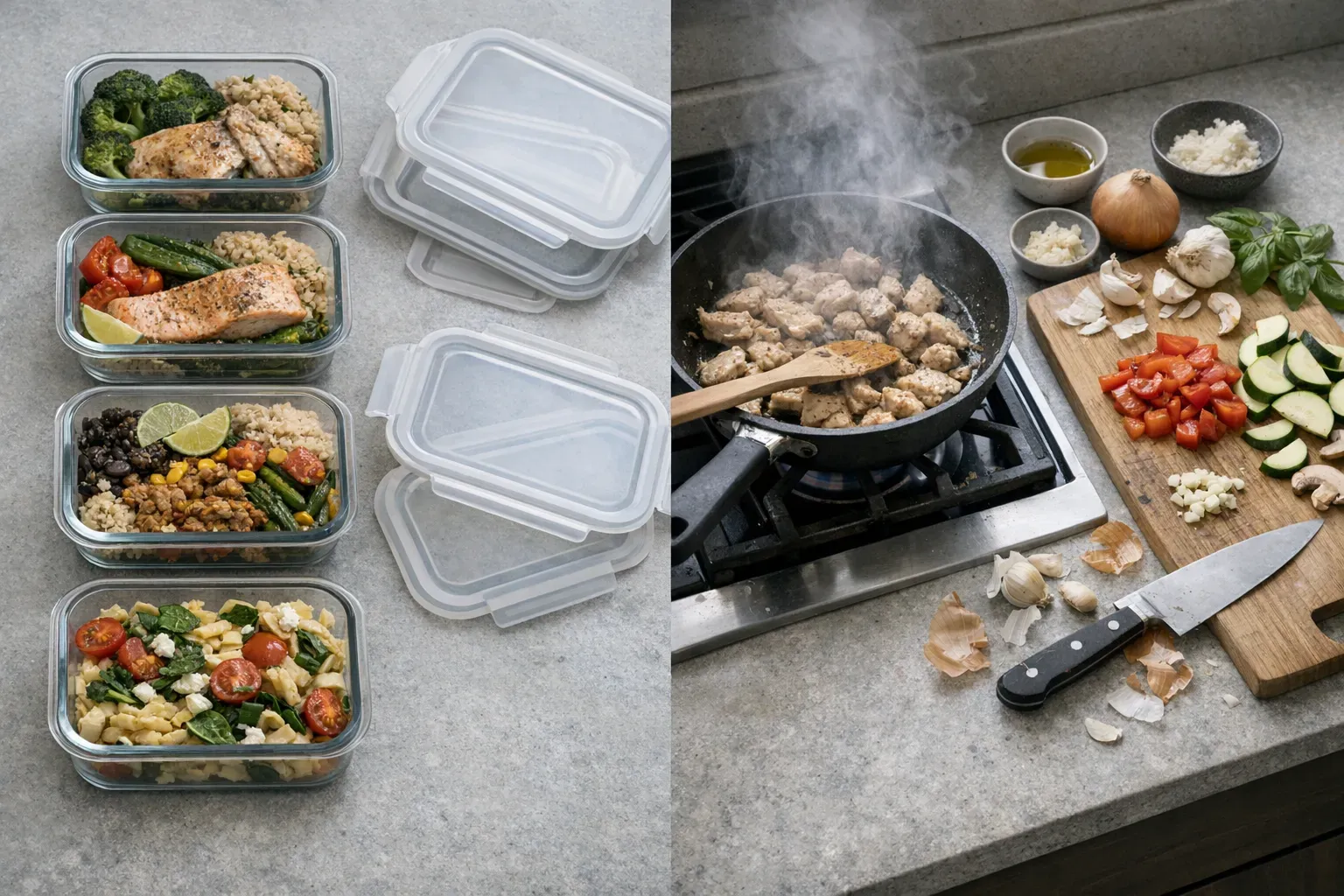
Meal prepping saves 5-7 hours per week compared to cooking daily, reduces food costs by 20-30%, but requires 2-4 hours upfront on prep day. Cooking daily offers maximum freshness and variety, takes 30-60 minutes per meal, and provides flexibility to adjust plans, but accumulates to 7-10 total hours weekly and often leads to more food waste.
For most busy families, a hybrid approach works best: prep components (proteins, grains, chopped vegetables) on Sunday, then assemble fresh meals in 15-20 minutes on weeknights.
Key Takeaways
- Meal prep takes 6-7 hours/week total (mostly upfront on Sunday) vs. 9-12 hours/week for daily cooking — a savings of 3-5 hours weekly
- Meal preppers spend $80-120/week on groceries for a family of 4, while daily cooks average $100-150/week due to smaller quantities, more shopping trips, and takeout fallbacks
- The hybrid approach (prep components Sunday, assemble fresh each night in 15-20 min) gives you meal prep’s efficiency with daily cooking’s freshness — about 4 hours total per week
- Daily cooking wins on freshness and flexibility; meal prep wins on cost, consistency, and weeknight ease — choose based on your schedule, not what sounds ideal
- Test one method for 3 full weeks before judging it, then adjust toward hybrid if neither extreme fits
In This Article
Time Comparison: The Real Numbers
Let’s break down exactly where time goes with each approach.
Meal Prep Time Investment
Sunday prep session:
- Planning meals and creating shopping list: 30 minutes
- Grocery shopping: 60 minutes
- Meal prep and cooking: 2-3 hours
- Cleanup: 30 minutes
- Total upfront: 4-5 hours
Weeknight assembly:
- Reheating or final assembly: 10-15 minutes per meal
- Cleanup: 10 minutes per meal
- Total per night: 20-25 minutes
- Weekly total for 5 weeknights: 100-125 minutes (1.5-2 hours)
Overall weekly time: 6-7 hours total
Daily Cooking Time Investment
Each weeknight:
- Deciding what to cook: 10-15 minutes
- Cooking from scratch: 30-60 minutes
- Cleanup: 15-20 minutes
- Total per night: 55-95 minutes
Weekly planning and shopping:
- Meal planning: 30 minutes
- Grocery shopping (2-3 trips): 90 minutes
- Total: 120 minutes (2 hours)
Overall weekly time: 9-12 hours total
Time savings with meal prep: 3-5 hours per week
This assumes full meal prep vs. completely from-scratch daily cooking. Most people fall somewhere in between, which affects the actual time difference.
Where Meal Prep Saves Time
Batch cooking is efficient. Cooking three chicken breasts takes barely longer than cooking one. Roasting five pounds of vegetables uses the same oven time as two pounds. You’re leveraging economies of scale.
Reduced decision-making. On a Tuesday night, you’re not staring at the fridge wondering what to make. You grab the prepped containers and assemble.
Consolidated grocery trips. One focused shopping trip vs. multiple quick trips saves both time and impulse purchases.
Streamlined cleanup. You clean your kitchen once on Sunday instead of doing significant cleanup five separate nights.
Where Daily Cooking Takes Time
Repeated tasks. You chop onions five times instead of once. You heat the pan, cook, and clean five separate times instead of consolidating.
Decision fatigue. Every night requires deciding what to cook, which slows down the process.
Multiple shopping trips. Many daily cooks shop 2-3 times weekly for fresh ingredients, adding travel time.
Nightly cleanup. Full cooking creates full cleanup, every single night.
Cost Comparison: The Financial Impact
Both approaches can be budget-friendly or expensive, depending on execution.
Meal Prep Cost Advantages
Buying in bulk saves 15-25%. Instead of buying one chicken breast, you buy a family pack. Instead of one bell pepper, you buy a bag. The per-unit cost drops significantly.
Less food waste. You prep exactly what you’ll use. If a recipe calls for half an onion, the other half gets used in another prepped meal, not forgotten in the fridge.
Fewer impulse purchases. One planned shopping trip means less browsing and fewer “oh, that looks good” additions to your cart.
Reduced takeout temptation. When dinner is already prepped, you’re far less likely to order $50 of takeout because you’re too tired to cook.
Typical weekly grocery cost for meal prep: $80-120 for family of 4 (assuming balanced, healthy meals)
Daily Cooking Cost Challenges
Smaller quantities cost more per serving. Individual chicken breasts cost $6-8/lb vs. $3-4/lb for family packs. Small portions of fresh produce often have higher per-pound costs.
Higher food waste. Buying fresh daily sounds wasteful-free, but in practice, you often buy more than needed for “flexibility,” and those ingredients spoil before use.
More frequent shopping = more spending. Studies show that each grocery trip averages $20-30 in unplanned purchases. Three trips weekly adds $60-90 in extra spending.
Convenience tax. When you’re cooking daily without prep, busy nights lead to takeout. Even one or two takeout meals weekly adds $40-100 to food costs.
Typical weekly cost for daily cooking: $100-150 for family of 4 (assuming some takeout supplementation)
Estimated savings with meal prep: $20-50 per week ($1,000-2,500 annually)
Full Comparison Table
Here’s a side-by-side breakdown of key factors:
| Factor | Meal Prep | Daily Cooking |
|---|---|---|
| Time per week | 6-7 hours total (mostly Sunday) | 9-12 hours (spread across week) |
| Upfront time | 4-5 hours on prep day | None |
| Daily time | 20-25 minutes | 55-95 minutes |
| Weekly grocery cost | $80-120 | $100-150 |
| Food waste | Minimal (10-15%) | Moderate to high (20-30%) |
| Variety | Limited to prepped meals | High (cook anything daily) |
| Freshness | Moderate (3-5 day old food) | Maximum |
| Flexibility | Low (meals already decided) | High (adjust daily) |
| Effort level | High upfront, low daily | Moderate consistently |
| Skill required | Batch cooking, planning | Standard cooking |
| Kitchen space | Need container storage | Standard |
| Best for | Consistent schedules, busy weeknights | Varied schedules, cooking enthusiasts |
Pros and Cons: The Full Picture
Understanding the tradeoffs helps you choose what fits your life.
Meal Prep Pros
Time efficiency during the week. Your weeknights are essentially free. Twenty minutes from fridge to table means more time for family, hobbies, or rest.
Portion control and nutrition tracking. You know exactly what and how much you’re eating. This is valuable for fitness goals or health conditions.
Reduced stress. No decision fatigue. No “what’s for dinner” panic. The work is already done.
Cost savings. Bulk buying, reduced waste, and fewer impulse purchases add up significantly.
Consistency. You eat home-cooked meals all week, not just when you have energy to cook.
Meal Prep Cons
Requires a significant time block. If you can’t dedicate 3-4 hours on Sunday, meal prep becomes difficult.
Taste degradation. Food on Thursday doesn’t taste as fresh as food on Sunday. Reheated meals lack the appeal of just-cooked food.
Limited variety within the week. You’re eating from a set menu. If you meal prep five containers of chicken and rice, you’re having chicken and rice five times.
Container storage. You need significant fridge space and a collection of containers.
Potential boredom. Eating the same prepped meals can feel monotonous, especially if you prep the same recipes repeatedly.
For a complete guide to making meal prep work, see our Meal Prep Sunday guide.
Daily Cooking Pros
Maximum freshness. Everything tastes better when it’s just cooked. Vegetables are crisp, proteins are juicy, nothing has that reheated quality.
Complete flexibility. Craving tacos? Make tacos. Want to try a new recipe? Go ahead. Your meal plan isn’t locked in.
Variety every night. You’re not eating the same thing multiple days in a row. Each dinner is different.
Satisfying for cooking enthusiasts. If you enjoy the process of cooking, daily cooking keeps that as part of your routine rather than condensing it to one day.
Better for changing appetites. Kids want pasta tonight? You can adjust. Someone not hungry? Make less. Daily cooking allows responsive meal decisions.
Daily Cooking Cons
Time-consuming. An hour-plus of cooking and cleanup every night adds up. That’s 5-7 hours weekly of active kitchen work.
Weeknight stress. After a long day, facing a 45-minute cooking session can be exhausting. This often leads to takeout or unhealthy shortcuts.
Decision fatigue. Deciding what to cook every single night is mentally draining.
More expensive. Higher per-unit costs, more waste, and more frequent takeout supplementation increase food spending.
Inconsistent nutrition. When you’re tired, you’re more likely to make quick, less nutritious choices.
If weeknights feel overwhelming, our guide on 20-minute dinners for busy weeknights offers faster cooking strategies.
The Hybrid Approach: Best of Both Worlds
Most successful home cooks don’t choose one extreme—they combine both approaches.
How Hybrid Meal Planning Works
Prep components, not complete meals. On Sunday, you batch cook proteins (grilled chicken, ground beef, roasted tofu), cook grains (rice, quinoa), and chop vegetables. These become building blocks for multiple different meals throughout the week.
Assemble fresh each night. Monday: use the chicken in tacos. Tuesday: add the ground beef to pasta. Wednesday: make a grain bowl with quinoa and vegetables. Each meal takes 15-20 minutes but tastes fresh.
Mix prepped and fresh meals. Prep 2-3 complete meals for your busiest nights (Monday, Wednesday). Cook fresh on nights when you have more time (weekends, lighter work days).
Strategic batch cooking. Make large batches of meals that freeze well (soups, chili, casseroles) and keep them frozen for emergencies, but cook fresh most nights.
Hybrid Approach Benefits
Time savings without taste sacrifice. You cut weeknight cooking from 60 minutes to 20 minutes, but food is assembled fresh, not reheated from Sunday.
More variety. The same grilled chicken becomes tacos, grain bowls, salad toppers, pasta additions—different meals from one prep session.
Better flexibility. If plans change, you have components ready but aren’t locked into specific complete meals.
Reduced stress with maintained quality. You get the weeknight ease of meal prep with the freshness of daily cooking.
Sample Hybrid Week
Sunday prep (90 minutes):
- Grill 3 lbs chicken breast
- Cook 6 cups brown rice
- Roast 4 lbs mixed vegetables
- Chop vegetables for quick use
Monday (15 minutes): Chicken tacos with fresh toppings, using prepped chicken and chopped vegetables
Tuesday (45 minutes): Fresh salmon with roasted vegetables (cook fresh, it’s a lighter day)
Wednesday (15 minutes): Grain bowls with prepped rice, chicken, and roasted vegetables
Thursday (20 minutes): Stir-fry using prepped chicken and fresh vegetables (quick cook)
Friday (5 minutes): Reheat Sunday’s prepped soup (easy end to the week)
This hybrid approach takes about 2 hours on Sunday plus roughly 2 hours across the week—4 hours total vs. 6-7 for full meal prep or 9-12 for daily cooking.
Who Should Meal Prep vs. Cook Daily?
Different lifestyles benefit from different approaches.
Meal Prep Works Best For:
Busy professionals with consistent schedules. If you leave work at 6pm every night and want to eat by 6:30pm, meal prep delivers.
People with fitness or health goals. Portion control and macro tracking are easiest with prepped meals.
Anyone who hates deciding what to cook. If meal planning is mentally exhausting, do it once weekly and be done.
Budget-conscious families. The cost savings are substantial and consistent.
People who eat similar meals regularly. If you’re happy eating chicken and rice multiple times weekly, meal prep works great.
Daily Cooking Works Best For:
Cooking enthusiasts. If cooking is relaxing or enjoyable, daily cooking keeps it in your routine.
People with flexible schedules. If you have time to cook most nights, daily cooking offers more variety.
Small households. Cooking fresh for one or two people is faster and creates less waste than batch cooking.
Those who prioritize maximum freshness. If reheated food doesn’t appeal to you, cook fresh.
Families with unpredictable appetites. If dinner plans change frequently, daily cooking adapts better.
Hybrid Works Best For:
Most families. Honestly, the hybrid approach fits most lifestyles because it combines efficiency with flexibility.
People transitioning from takeout. Start with component prep to make home cooking faster without the full commitment of meal prep.
Households with varied schedules. Prep for busy nights, cook fresh when you have time.
Learn how to structure your complete weekly system in our complete weekly meal planning guide.
Making Your Decision
Here’s how to choose what works for you.
Track your current time. For one week, record how long meal planning, shopping, cooking, and cleanup take. This gives you a baseline.
Calculate your costs. Track grocery spending and takeout for two weeks. Be honest about total food costs.
Consider your constraints. Do you have a 3-hour block on weekends? Do you get home at 7pm on weeknights? Let your schedule guide the approach.
Test one method for 3 weeks. Don’t judge after one week. Give it three weeks to become routine, then evaluate.
Adjust based on results. If full meal prep feels too limiting, try the hybrid approach. If daily cooking is too time-consuming, add more prep.
Don’t aim for perfection. Even meal preppers cook fresh sometimes. Even daily cooks prep components occasionally. Allow flexibility.
Common Questions
Can I meal prep if I live alone?
Yes, but scale appropriately. Prep 2-3 servings of each meal instead of 5-6. Consider freezing half for future weeks. Living alone actually makes meal prep more valuable because cooking single servings daily is inefficient.
How long does prepped food stay fresh?
Most prepped meals stay fresh 3-5 days in the fridge. Cook on Sunday and you’re safe through Thursday. Friday meals should either be frozen initially and thawed Thursday, or cooked fresh.
Is daily cooking healthier than meal prep?
Not necessarily. Both can be healthy or unhealthy depending on what you cook. Meal prep offers better portion control; daily cooking offers fresher vegetables. Health depends on your food choices, not your prep method.
What if I hate my prepped meals by Wednesday?
This is common with full meal prep. Switch to the hybrid approach—prep components instead of complete meals, allowing more variety. Or prep just 2-3 meals and cook fresh other nights.
Can I meal prep and still have family dinners?
Absolutely. Meal prep doesn’t mean everyone eats alone from containers. Prep the food on Sunday, then serve it family-style at dinner each night. It’s still home-cooked food shared together; you just did the cooking in advance.
Start With What Fits Your Life
There’s no universal “best” approach to meal planning and cooking. The right choice depends on your schedule, priorities, and preferences.
If you value time efficiency and cost savings above all else, commit to meal prep. If you prioritize freshness and variety and have time to cook, embrace daily cooking. And if you want balance, try the hybrid approach that gives you both efficiency and flexibility.
Start with whatever feels most sustainable. Experiment for a few weeks. Adjust based on what actually works in your life, not what sounds good in theory.
Whether you meal prep, cook daily, or combine both, having a system eliminates the stress of figuring out dinner every night. That consistency—not the specific method—is what transforms mealtime from a daily challenge into a manageable routine.
Tavola helps you implement whichever approach fits your life. Track your recipes, organize your weekly plan, and generate grocery lists whether you’re prepping Sunday for the whole week or cooking fresh each night. The system adapts to your method while handling the logistics that slow you down.