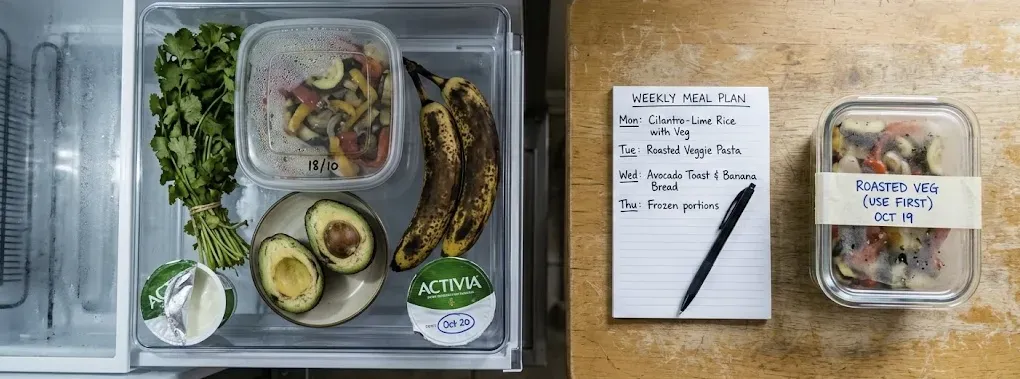
The average American household throws away roughly 30-40% of the food it buys — about $1,500 worth every year. Meal planning is the single most effective way to reduce food waste at home because it ensures you buy only what you need, use what you buy, and turn leftovers into intentional meals instead of forgotten fridge experiments.
The fix isn’t complicated. It’s a shift from reactive cooking (buying random ingredients, hoping meals happen) to intentional cooking (planning meals, shopping with purpose, using everything you buy). Most families cut food waste by 50-75% within a month of consistent meal planning.
Key Takeaways
- Americans waste 30-40% of purchased food, costing the average household $1,500 annually in thrown-away groceries
- The biggest waste culprits are forgotten leftovers, overbuying perishables, and impulse purchases that never become meals
- A simple “use-first” system (plan meals around what’s already in your fridge) eliminates the most common source of waste
- Freezing strategically — proteins on purchase day, batch-cooked meals, ripe produce — extends food life by weeks or months
- Meal planning reduces food waste by 50-75% because every purchase has a purpose and every leftover has a plan
In This Article
- Why We Waste So Much Food
- The 5 Biggest Food Waste Culprits at Home
- How Meal Planning Stops Food Waste
- 7 Practical Strategies to Reduce Food Waste
- The “Use-First” Meal Planning Method
- Smart Storage: Making Food Last Longer
- What to Do When Food Is About to Expire
- Tracking Your Waste to Measure Progress
- FAQ: Reducing Food Waste at Home
- Less Waste, More Meals That Matter
Why We Waste So Much Food
Food waste isn’t a personal failure — it’s a system problem. Modern grocery stores are designed to encourage overbuying. Produce is sold in quantities larger than most households need. Confusing date labels (“best by” vs. “use by” vs. “sell by”) cause people to throw away perfectly safe food. And busy schedules mean good intentions often don’t translate into actual cooking.
According to the USDA, the largest category of food waste in American landfills is fruits and vegetables, followed by dairy, meat, and grains. Most of this waste happens at home, not at farms or grocery stores.
The environmental cost is significant too. Food decomposing in landfills produces methane, a greenhouse gas 80 times more potent than CO2 over a 20-year period. Reducing household food waste is one of the most impactful environmental actions an individual can take.
But here’s the encouraging part: unlike industrial food waste, household food waste is entirely within your control. And the solution starts with a plan.
The 5 Biggest Food Waste Culprits at Home
Before fixing the problem, it helps to understand exactly where food waste happens in your kitchen:
1. Forgotten Leftovers
That container of Tuesday’s chili pushed to the back of the fridge, rediscovered two weeks later. Leftover rice from takeout that nobody reheated. Half a casserole that seemed like too little to serve again but too much to throw away.
Typical waste: $8-$15 per week
2. Overbuying Fresh Produce
You bought a bag of spinach with the best intentions. A week later, it’s a slimy green puddle. The bananas ripened faster than anyone could eat them. The herbs from one recipe wilted before you found a second use.
Typical waste: $10-$20 per week
3. Impulse Ingredients That Never Become Meals
That interesting sauce you grabbed, the exotic vegetable you planned to try, the specialty cheese that sounded good in the store. Without a specific recipe attached, these items sit unused until they expire.
Typical waste: $5-$10 per week
4. Misunderstood Date Labels
“Best by” dates indicate peak quality, not safety. Most foods remain perfectly safe days or even weeks past these dates. Yet studies show 84% of consumers throw away food near the package date at least occasionally, discarding billions in edible food annually.
Typical waste: $5-$10 per week
5. Cooking Too Much Without a Leftovers Plan
Making a full recipe when you only need half the servings, without a plan for what to do with the rest. The excess gets refrigerated, forgotten, and eventually tossed.
Typical waste: $5-$10 per week
Combined weekly waste: $33-$65 per household, or $1,700-$3,380 annually.
How Meal Planning Stops Food Waste
Meal planning attacks food waste at its root — the gap between what you buy and what you actually eat.
Every purchase has a purpose: When you plan meals before shopping, every item on your list connects to a specific recipe. No orphan ingredients sitting unused.
Perishables get used in order: You schedule meals so that delicate items (fish, leafy greens, fresh herbs) get used early in the week, while hardier ingredients (root vegetables, frozen proteins, dried goods) are saved for later.
Leftovers become intentional: Instead of hoping someone eats Tuesday’s leftovers, you plan Wednesday’s dinner around them. Roast chicken becomes chicken salad. Extra rice becomes fried rice. It’s not leftovers — it’s meal prep.
You buy realistic quantities: When you know you’re cooking 4-5 dinners this week, you buy ingredients for 4-5 dinners. Not aspirational ingredients for 7 elaborate meals you won’t have time to cook.
For a complete beginner’s framework for weekly meal planning, see our beginner’s guide to meal planning.
7 Practical Strategies to Reduce Food Waste
1. Do a Fridge Audit Before Planning
Before writing your meal plan, open the fridge and take stock. What proteins need cooking in the next 2-3 days? Which vegetables are approaching their limit? Is there leftover rice, pasta, or sauce that could become part of a new meal?
Build at least 1-2 of your weekly meals around what’s already in the fridge. This single habit eliminates the most common source of waste.
2. Plan Meals in Freshness Order
Schedule your week’s meals based on ingredient perishability:
| Day | Meal Strategy | Example |
|---|---|---|
| Monday-Tuesday | Use most perishable items first | Fresh fish, leafy greens, ripe avocados |
| Wednesday-Thursday | Use moderately perishable items | Chicken, bell peppers, broccoli |
| Friday | Leftovers night or pantry meal | Remix earlier meals or use shelf-stable items |
| Weekend | Flexible — shop again or use freezer items | Frozen proteins, root vegetables, canned goods |
This ensures nothing spoils before you get to it.
3. Overlap Ingredients Across Meals
Plan meals that share perishable ingredients so nothing goes to waste:
- Cilantro: Tacos on Monday, Vietnamese noodle bowls on Wednesday
- Fresh basil: Caprese salad on Tuesday, pesto pasta on Thursday
- Half a cabbage: Coleslaw on Monday, stir-fry on Wednesday
- Lemons: Lemon chicken on Tuesday, lemon vinaigrette for Friday salad
When a recipe calls for half a bunch of parsley, your next meal should use the other half.
4. Master the “Leftover Remix”
Transform leftovers into entirely different meals so they feel intentional, not repetitive:
- Roast chicken → chicken quesadillas, chicken soup, or chicken Caesar wraps
- Cooked rice → fried rice, rice bowls, or stuffed peppers
- Roasted vegetables → frittata, grain bowls, or blended into soup
- Pasta sauce → pizza base, shakshuka-style eggs, or bruschetta topping
- Taco meat → nachos, stuffed baked potatoes, or taco salad
Schedule one “remix night” per week where the entire dinner is built from earlier meals. More leftover transformation ideas in our guide on meal prep without getting bored.
5. Freeze Strategically
Your freezer is a pause button for food waste:
Freeze immediately on shopping day: Proteins you won’t use within 2 days. Label with contents and date.
Freeze ripe produce: Overripe bananas (peel first), berries about to turn, chopped herbs in olive oil in ice cube trays, wilting spinach (blanch first).
Freeze batch-cooked meals: Soups, stews, sauces, and casseroles freeze beautifully for 2-3 months. Cook once, eat multiple times.
Freeze bread: Bread goes stale faster than most families can eat it. Freeze half the loaf on purchase day and thaw slices as needed.
For more on freezer-friendly cooking, check out our freezer-friendly meals guide.
6. Understand Date Labels
Stop throwing away perfectly good food:
| Label | What It Actually Means | Should You Toss It? |
|---|---|---|
| ”Best by” | Peak quality date, not safety | No — usually fine days or weeks past this date |
| ”Sell by” | Store inventory management | No — food is safe well after this date |
| ”Use by” | Manufacturer’s quality recommendation | Check the food — usually still safe shortly after |
| ”Expires on” | Only on infant formula — the one date to follow strictly | Yes, for infant formula only |
Trust your senses: If food looks normal, smells normal, and tastes normal, it’s almost certainly safe. The date on the package is about quality, not safety (except infant formula).
7. Keep a “Use Soon” Zone in Your Fridge
Designate one shelf or bin in your fridge as the “use first” zone. Anything approaching its limit goes here — the yogurt expiring in two days, the leftover soup from Monday, the herbs that won’t last another week.
When you meal plan or reach for a snack, check this zone first. It’s a simple visual system that prevents food from being forgotten behind newer purchases.
The “Use-First” Meal Planning Method
Here’s a complete weekly workflow that minimizes waste:
Step 1: Inventory (5 minutes) Open your fridge, freezer, and pantry. List items that need using within the week. Note quantities.
Step 2: Build meals around inventory (5 minutes) Create 2-3 meals using items you already have. These become your first meals of the week.
Step 3: Plan remaining meals (5 minutes) Add 2-3 more meals to complete the week. Choose recipes with overlapping fresh ingredients.
Step 4: Create a precise shopping list (3 minutes) List only what you need for the new meals, minus what you already have. Be specific with quantities — “2 chicken breasts” not “chicken.”
Step 5: Designate a remix night (1 minute) Block one evening for leftovers. Don’t plan or buy anything for this night.
Total planning time: About 20 minutes per week, and you’ll waste dramatically less food.
This approach works especially well when combined with a well-organized grocery list that prevents overbuying at the store.
Smart Storage: Making Food Last Longer
Proper storage extends the life of produce by days or even weeks:
Herbs (parsley, cilantro, dill): Trim stems and store upright in a glass of water in the fridge, covered loosely with a plastic bag. Lasts 2-3 weeks instead of 3-4 days.
Leafy greens (spinach, lettuce, kale): Wash, dry thoroughly, and store in a container lined with paper towels. The towels absorb moisture that causes wilting.
Berries: Don’t wash until you’re ready to eat. Store in a single layer on paper towels. Rinse in a vinegar-water solution (1:3 ratio) before eating to remove mold spores and extend freshness by 3-5 days.
Avocados: Store unripe avocados at room temperature. Once ripe, move to the fridge to slow ripening by 2-3 days. Cut avocados keep best with the pit in, wrapped tightly.
Bread: Store at room temperature for 2-3 days. Freeze the rest immediately — frozen bread toasts perfectly.
Cheese: Wrap in wax paper or parchment, then loosely in plastic wrap. Never in just plastic wrap, which traps moisture and accelerates mold.
Tomatoes: Store at room temperature until ripe. Refrigerating unripe tomatoes kills flavor and texture permanently.
What to Do When Food Is About to Expire
When ingredients are on the edge, act fast:
Vegetables going soft: Make soup or stock. Almost any combination of vegetables can become a soup with broth, salt, and an immersion blender.
Fruit past its prime: Smoothies, banana bread, fruit crisps, or freeze for later smoothies. Overripe fruit is actually sweeter and better for baking.
Bread going stale: Make breadcrumbs (pulse in food processor and freeze), croutons (cube, toss with oil, bake at 375°F), or French toast.
Dairy nearing expiration: Hard cheeses last weeks past their date. Yogurt lasts 1-2 weeks past its date. Milk can be frozen for cooking use.
Cooked leftovers on day 3-4: Freeze them immediately rather than waiting another day. They’ll be perfectly good for 2-3 months frozen.
Tracking Your Waste to Measure Progress
You can’t improve what you don’t measure. For one week, track everything you throw away:
- Keep a waste log: Place a notepad near your trash can. Write down every food item you discard.
- Note the reason: Was it forgotten leftovers? Expired produce? Over-cooked portions nobody ate?
- Estimate the cost: Rough dollar amounts for each item.
- Identify your top 3 waste categories: These are your starting points for improvement.
After implementing meal planning for a month, repeat the exercise. Most families see a 50-75% reduction in food waste, which translates directly to grocery savings.
For more strategies on saving money through planning, see our guide on cutting your grocery bill with meal planning.
FAQ: Reducing Food Waste at Home
What is the number one way to reduce food waste at home?
Meal planning is the single most effective strategy for reducing food waste at home. By planning meals before grocery shopping, you buy only what you need, use perishables in order of freshness, and turn leftovers into intentional meals. Families who meal plan consistently reduce food waste by 50-75% and save $750-$1,500 annually on groceries.
What are the most wasted foods in American households?
Fruits and vegetables top the list, accounting for nearly 40% of household food waste. This is followed by dairy products, bread and baked goods, meat, and prepared leftovers. The common thread is perishability — these items spoil quickly when purchased without a specific meal plan, making intentional shopping and proper storage critical for waste reduction.
How can I stop throwing away produce?
Three strategies work best: plan meals in freshness order (use delicate greens early in the week, hardy root vegetables later), overlap ingredients across meals so nothing sits unused, and freeze produce that’s about to turn (bananas, berries, spinach, herbs in oil). Also, store produce correctly — herbs in water, greens on paper towels, tomatoes at room temperature — to extend their shelf life significantly.
Is it safe to eat food past the “best by” date?
In most cases, yes. “Best by” and “sell by” dates indicate peak quality, not safety. Food is typically safe for days or weeks beyond these dates. The exception is infant formula, where “expires on” dates should be strictly followed. For all other foods, trust your senses: if it looks, smells, and tastes normal, it’s almost certainly safe to eat.
How much food does the average family waste per year?
The average American household wastes approximately 30-40% of purchased food, costing roughly $1,500 per year. For a family of four spending $200 per week on groceries, that’s about $60-$80 worth of food thrown away weekly. The biggest contributors are spoiled produce, forgotten leftovers, and impulse purchases that never become complete meals.
Less Waste, More Meals That Matter
Reducing food waste isn’t about perfection. It’s about small, consistent habits: checking what you have before shopping, planning meals around what needs using, freezing what you can’t eat in time, and giving leftovers a second life as something new.
Start with your fridge this week. What’s in there that needs eating? Build your next two meals around those ingredients. That’s meal planning at its simplest — and it’s where waste reduction begins.
Tavola helps busy families spend less time planning and more time around the table — because every family recipe tells a story worth preserving, and the best ingredient is one that actually gets used.